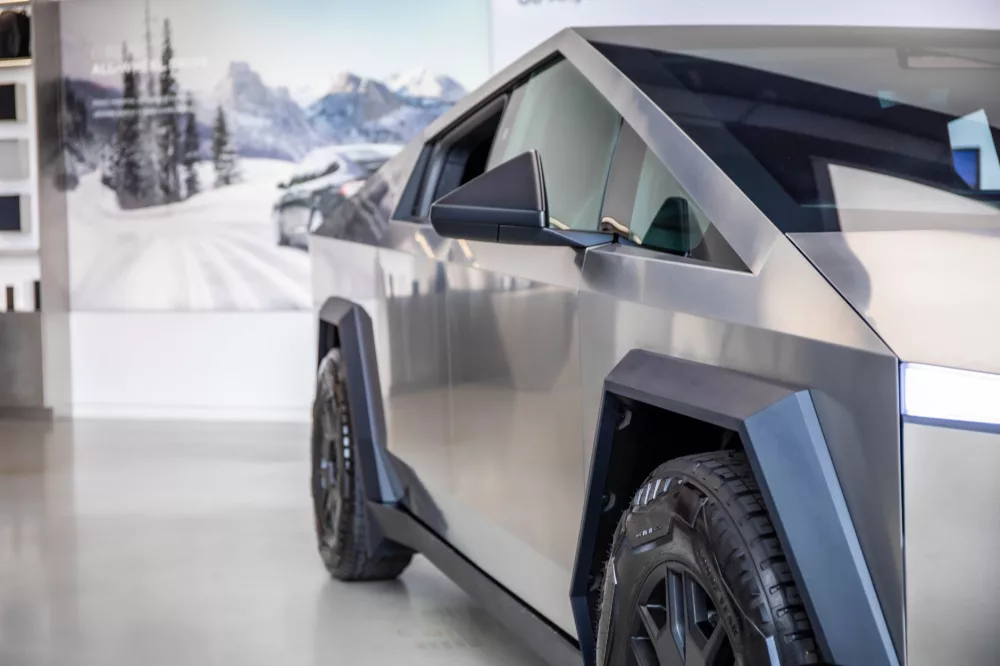
The Tesla Cybertruck: An Unconventional Bet on the Future of Trucks
When Elon Musk first unveiled the Tesla Cybertruck back in November 2019, I'm pretty sure no one, not even the most ardent Tesla fan, was fully prepared for what they saw. It wasn't just a new electric pickup truck; it was a radical, almost alien, reinterpretation of what a truck could and should look like. Four years later, after a journey filled with anticipation, delays, and a whole lot of head-scratching, it's finally on the road. And honestly, it’s still as polarizing as ever, which I find absolutely fascinating.
My initial reaction, like many, was a mix of awe and bewilderment. Was this a prop from a sci-fi movie, or a genuine production vehicle? As I've followed its development, I've come to understand its design philosophy a bit better. This isn't just about making an electric truck; it's about challenging every single preconception we have about vehicle manufacturing and aesthetics. I think that's why it resonates so much with some people, and completely alienates others. You can't accuse Tesla of playing it safe here, can you?
Radical Design & Unyielding Materials
Let's talk about that design first, because it's impossible not to. The Cybertruck's angular, unpainted stainless steel exoskeleton is its defining feature. Tesla calls it 'Ultra-Hard 30X Cold-Rolled Stainless Steel,' and it's designed to be incredibly durable. My understanding is that this material choice isn't just for looks; it's a structural component. The body isn't simply bolted onto a frame; the exterior panels are the structure, providing exceptional rigidity and, as they've demonstrated (albeit controversially with the shattered window incident), impact resistance. I find this approach incredibly bold, shifting away from traditional body-on-frame or unibody constructions for something entirely different.
This material also presented significant manufacturing challenges, as we've learned over the years. Shaping and welding stainless steel of this thickness isn't easy, and it certainly contributed to the production delays. But the benefit, according to Tesla, is a vehicle that's dent-resistant, scratch-resistant, and won't rust. Imagine a truck that basically looks new for years without needing paint! That's a pretty compelling argument for a work vehicle, if you ask me.
Performance That Defies Expectations
Beyond its looks, the performance figures for the Cybertruck are genuinely breathtaking, especially for a vehicle of its size and weight. I remember seeing the initial specs and thinking, 'No way.' But here we are.
- 0-60 mph: The top-tier 'Cyberbeast' variant can hit 60 mph in just 2.6 seconds. That's faster than many high-performance sports cars, which is insane for a pickup truck.
- Range: Tesla initially promised ambitious range numbers, and while the production versions aren't quite at the very top of those initial estimates without the range extender, they're still very competitive. The 'All-Wheel Drive' version offers an estimated 340 miles, and the 'Cyberbeast' gets 320 miles. There's also the option for an additional range extender battery pack that fits into the bed, bumping the range up significantly, which I think is a clever solution.
- Towing Capacity: It boasts an impressive 11,000 pounds of towing capacity. For most truck owners, that's more than enough for boats, trailers, or even smaller RVs. I've always thought electric torque would be a game-changer for towing, and the Cybertruck certainly delivers on that promise.
These numbers aren't just good for an electric truck; they're excellent for any truck. It makes me wonder how traditional truck manufacturers will respond in the long run.
A Peek Inside: Utilitarian Futurism
Stepping inside the Cybertruck is another experience entirely. If the exterior is minimalist brutalism, the interior is minimalist futurism. It's spacious, with a huge 18.5-inch central touchscreen dominating the dashboard. There are very few physical buttons, which is typical Tesla, but in the Cybertruck, I feel it enhances the clean, industrial aesthetic.
The six-seat configuration (three front, three rear) is interesting, though the front middle seat is more of an occasional jump seat. I appreciate the panoramic glass roof, which really opens up the cabin and makes it feel even larger. The materials inside seem robust and easy to clean, which is a definite plus for a utility vehicle. It’s not about luxury in the traditional sense; it’s about a new kind of functional luxury, one that prioritizes space, technology, and durability. That's my take on it, anyway.
Utility & Off-Road Prowess
A truck isn't a truck without utility, and the Cybertruck tries to reinvent that too. The 'Vault' is what Tesla calls its 6-foot bed, which comes with a powered tonneau cover and a ramp that can slide out for loading. I think the integrated tonneau cover is a really smart feature, enhancing security and aerodynamics. The bed also has 120V and 240V power outlets, turning the truck into a mobile power station, which is incredibly useful for work sites or camping.
Its adaptive air suspension offers up to 17 inches of ground clearance, and combined with electronic torque vectoring, it promises serious off-road capability. I've seen some videos of it tackling tough terrain, and it seems quite capable. The steer-by-wire system and rear-wheel steering mean it has a surprisingly tight turning radius for such a large vehicle, making it more maneuverable in tight spots than you'd expect. That's a huge benefit, especially in urban environments or on trails.
Production Challenges and the Road Ahead
The journey to production for the Cybertruck was, let's just say, protracted. From initial unveil to first deliveries, it took over four years. Manufacturing the stainless steel body, perfecting the battery technology, and scaling production proved to be immense hurdles. I remember Elon Musk himself stating the challenges, describing it as 'insanely difficult.' This level of innovation often comes with significant growing pains, and the Cybertruck's story is a prime example.
Now that it's on the road, the real-world performance, durability, and long-term reliability will be under intense scrutiny. It's not just competing with other electric trucks like the Ford F-150 Lightning or Rivian R1T; it's also competing with the established dominance of traditional gasoline-powered pickups. I think its success will hinge on whether it can convince truck buyers, who are often very traditional in their preferences, that its unconventional approach is not just a novelty, but a superior way forward.
In my opinion, the Tesla Cybertruck isn't just a vehicle; it's a statement. It represents a bold leap into what Tesla believes is the future of automotive design and engineering. It's not for everyone, and it doesn't try to be. But for those who embrace its radical vision, I'm sure it offers a driving and ownership experience unlike anything else on the market today. We're witnessing the evolution of the pickup truck, and the Cybertruck is certainly leading that charge in its own unique, audacious way. It's gonna be interesting to see how it shapes the truck market in the coming years; I'm certainly watching closely.